Cole frowned as he watched Imad shamble down the hallway outside the department office. His steps were uneven, and he steadied himself by bracing his hand against the wall. There was always a draft on the second floor of Whateley Hall, but Imad was wearing far too many sweaters for June.
Cole left his desk and stood in the office doorway. “You doing okay, buddy?” he asked.
Imad regarded him with eyes that seemed too big for his face. “I’ve been under the weather,” he replied. “Too much reading. You know how it is.”
“I’m more of an audiobook man myself.” Cole cleared his throat. “Listen, Imad. I don’t mean to be rude, but you don’t look so great. Do you want to sit down before you head out? I’ve still got some soda from the graduation party in the minifridge. You’d be doing me a favor if you took one.”
A wan smile surfaced on Imad’s face. He took a step toward the office, but his expression twisted into a grimace as his laptop bag shifted against his side. “Thanks, but I’d better get going,” he muttered.
“Are you sure you don’t want me to call someone? Like a Lyft or something?” Cole offered, but Imad shook his head and slipped through the door to the stairs.
Cole watched as he left. It was hard to tell in the dim light of the corridor, but he could have sworn he saw a sheen of sweat on Imad’s forehead. It was probably nothing more serious than a summer cold, but Cole wondered what Imad could have read to make his face so pale.
As he indulged in speculation, Cole’s imagination got the better of him. Miskatonic University was famous for housing a large collection of books once deemed heretical by the large universities in Boston. Even today, books bound in human skin occupied a substantial division of the library archives. What if Imad had gotten sick from contact with one of the books in the special collections?
A story about a forbidden book would make a great podcast episode. The most downloaded episode on Cole’s feed was a story about a cursed doll he’d found on Etsy. Creepy dolls were a dime a dozen, but the pink mildew poking out of this doll’s cracked porcelain scalp was something special. The listing said the seller was local, so Cole sent her a message and requested an in-person viewing of the doll. The seller immediately replied with her address.
When Cole drove over, he found the doll perched on the edge of the rotting concrete porch of an abandoned wastewater plant. It sat in a puddle of something that wasn’t quite liquid. Cole was painfully aware that he’d walked headlong into a prank, but he didn’t touch the doll. He had no interest in mucking about with the neon fungus infesting its hair, but he was more than happy to take a photo.
Cole invented a lurid story about the doll for his podcast. Sure enough, listeners loved it. He resented the popularity of such obvious clickbait, but it served its purpose. For a time, at least. As was so often the case with online content, interest waned quickly. He needed another hit. Cole fancied himself to be a literary horror specialist, and he used his show to discuss writers like M.R. James and Elizabeth Gaskell alongside twentieth-century film noir. An episode about a cursed book had the potential to draw an audience, and it would be a much better ambassador for the show than a fabricated story about a cursed doll.
When he introduced himself at department parties, Cole didn’t hesitate to tell new acquaintances that he hosted a podcast. He’d even printed a business card on handsome matte black cardstock with his name and website. Most people accepted the card, but very few asked him what he meant when he described his field as “dark academia.” Perhaps they assumed he was complaining about grad school.
To be fair, Cole had tried his hand at a graduate program, but only briefly, and only at a small department at a state school in Ohio. The college’s fluorescent-lit cinderblock buildings didn’t contribute to a scholarly state of mind, and Cole dropped out after his first semester. He took the opportunity to relocate to Boston, where he found a job writing copy for the alumni magazine of a liberal arts school.
Far from being the ancient and shadow-blighted city he’d read so much about, Boston was a textbook case of gentrification, especially the neighborhood around the university. After a year of mounting debt with nary a Gothic spire in sight, Cole found a listing for an administrative assistant at the Classics Department of Miskatonic University in Arkham. There wasn’t much charm or prestige out in the Essex County suburbs, but it was hard to deny the lure of cutting his rent in half.
Cole was interviewed by the department chair, a harassed-looking elderly gentleman in a threadbare blazer. The chair informed Cole that there were no other applicants, and that the position was his if he wanted it. He would be working under the head administrator, a cheerful red-faced woman named Peggy who introduced herself with a wave. The chair didn’t seem overly concerned with how the department was run, and Cole suspected that Peggy had acquired the blush on her cheeks from a liquid lunch. He accepted the job on the spot.
The Classics Department was like any other office, equipped with outdated computers and furniture straight from wholesale. The industrial wall-to-wall carpeting bore the stains of years of department parties, and a neglected snake plant struggled valiantly by the lone window. Cole didn’t see much of the professors, and the grad students were an uninspiring bunch interested primarily in gossip.
Imad was different. As far as Cole could tell, he was the only person who made use of the shared grad student office. He came in every afternoon, and he always stopped by the department office to say hello before disappearing into the small room at the end of the corridor.
Imad told Cole that he was working on his dissertation, a comparison of Near Eastern gnostic texts from the seventh and eighth centuries. He more properly belonged to the Religious Studies department, he’d explained, but it was dissolved the same semester he finished his coursework. Cole didn’t follow his breakdown of the situation, which had something to do with falling enrollments and shrinking budgets, but he understood that Imad had been taken in by the Classics Department as a courtesy.
Cole asked about the progress of Imad’s work every afternoon, and Imad was always ready with a concise and practical explanation. It didn’t escape Cole’s notice that Imad was blessed with a mellow yet resonant voice that would sound excellent on tape.
Cole gradually developed a casual friendship with Imad over the course of the spring semester, and he came to look forward to Imad’s visits to the office. Once classes ended and the students disappeared from campus, however, Imad started to change. He lost weight, and his cheeks became so hollow that his eyes seemed to bulge from his face. The golden tan of his skin faded to a sickly olive. His beard was patchy and uneven.
And there was another thing. Imad had begun to smell. The odor that lingered behind him wasn’t unpleasant, but it was odd. The smell reminded Cole of wet asphalt drying in the sun after the rain. Or like an antique doll sitting in a puddle of creosotic slime outside an abandoned water treatment plant in the twilight of rural Ohio.
Cursed book or not, something was going on, and Cole figured that he owed it to himself to get to the bottom of whatever was troubling Imad. With almost no work over the summer and a boss who only rarely bothered to show up to the office, it’s not as if he had anything else to do.
There weren’t many students on campus during the summer. Truth be told, there weren’t many students on campus during the school year. Cole was given to understand that Miskatonic’s enrollments had been falling with each successive semester. This didn’t surprise him. The campus was filled with stately old buildings, but none of them had been maintained for years. The gym had been built in the 1970s, and the dorms a decade earlier. It wasn’t the sort of place that attracted students.
Regardless, Cole was required to be in the office until the end of working hours. He replied to emails in the morning and spent the afternoon in comfortable solitude searching for stories online.
He’d recently started researching the Theosophical Society Lodge next to campus. The Lodge had supposedly held seances well into the twentieth century, but they apparently stopped on the eve of the Great War. The building now housed a library that served as a stage for public lectures on world religions, some of which had been recorded.
Cole had just downloaded the most recent lecture when Imad walked into the office. He looked even worse than usual. His face had gone from olive to yellow, and the sheen of grease on his forehead was unmistakable.
Cole swallowed his shock as he greeted Imad. “Hey, so,” he began. “I was reading about modern Gnosticism. Not much to do here over the summer, right? And I was wondering. How would you pronounce, ah, Mandaeism?”
“Mandaeism? You pronounced it correctly. The Arabic is al-Mandāʾiyya, but Mandaeism is fine for general use. Why do you ask?”
“I was fishing for material for my podcast. I read that a lot of Iraqis moved to the suburbs of DC during the early 2000s. Apparently, one community brought lead amulets written in a form of Aramaic that no one at the Smithsonian can read.”
“I wouldn’t say that no one can read them,” Imad replied. “Even if the ganzibria priests couldn’t transliterate the written text, they’d be able to recite the historiola.”
“The historiola? I’m sorry, I’m not familiar with that term.”
“A historiola is a short story about a ritual. The act of reading the story functions as a performance of the ritual itself, like a magic spell.”
“How does that work?” Cole asked.
Imad shrugged. “It’s magic. Who can say how it works? Still, it’s probably for the best that no one at the Smithsonian can read the amulets. You wouldn’t want to pronounce the Aramaic with too much accuracy. If the divine creator brought this world into existence with a word, it stands to reason that another word might open the gates between worlds. That’s a metaphor for the expansiveness of spirituality, of course,” he added with a smile, “but one can never be too careful.”
“Interesting,” Cole said, and it was. The idea that the act of reading could serve as a magic ritual was intriguing. “So what are you translating this afternoon?”
“Well,” Imad started to say, but he winced as he leaned against the waist-high counter separating the office from the faculty mailboxes. It could have been a trick of the light, but something seemed to ripple under his layers of sweaters.
Imad caught the look of concern on Cole’s face. “Sorry,” he said as he turned toward the door. “I might have had too much tea with lunch. I’m going to visit the bathroom and head to my office.”
Cole nodded and returned his eyes to his computer screen, hoping that he’d staged a decent performance of polite interest. He hesitated to cross the line of professional distance with the members of his department. He couldn’t afford to move back to Boston, and he needed this job. Arkham wasn’t the most prosperous suburb, and the only other paying work he’d be likely to find here was at the fulfillment center warehouse by the highway.
Still, he liked Imad. Professionalism be damned.
Later that afternoon, he brewed two bags of mint tea in paper cups and carried them down the hall to the graduate student office. When Imad answered the door, Cole was struck by the wet smell that emerged from the room. It was as if something spilled on the carpet and never dried properly.
“So I was thinking,” he said, “no one is using the department chair’s office over the summer. I was planning to air it out a bit. Care to join me?”
The chair’s office was lined with floor-to-ceiling bookshelves and equipped with the sort of grommeted furniture that populated movies about gentlemen explorers. It smelled like fine paper and old leather, and the sunlight that filtered through the cloudy panes of glass in the mullioned windows was bright but gentle.
“Are you sure you don’t want to tell me what you’re working on?” Cole asked as he sat down.
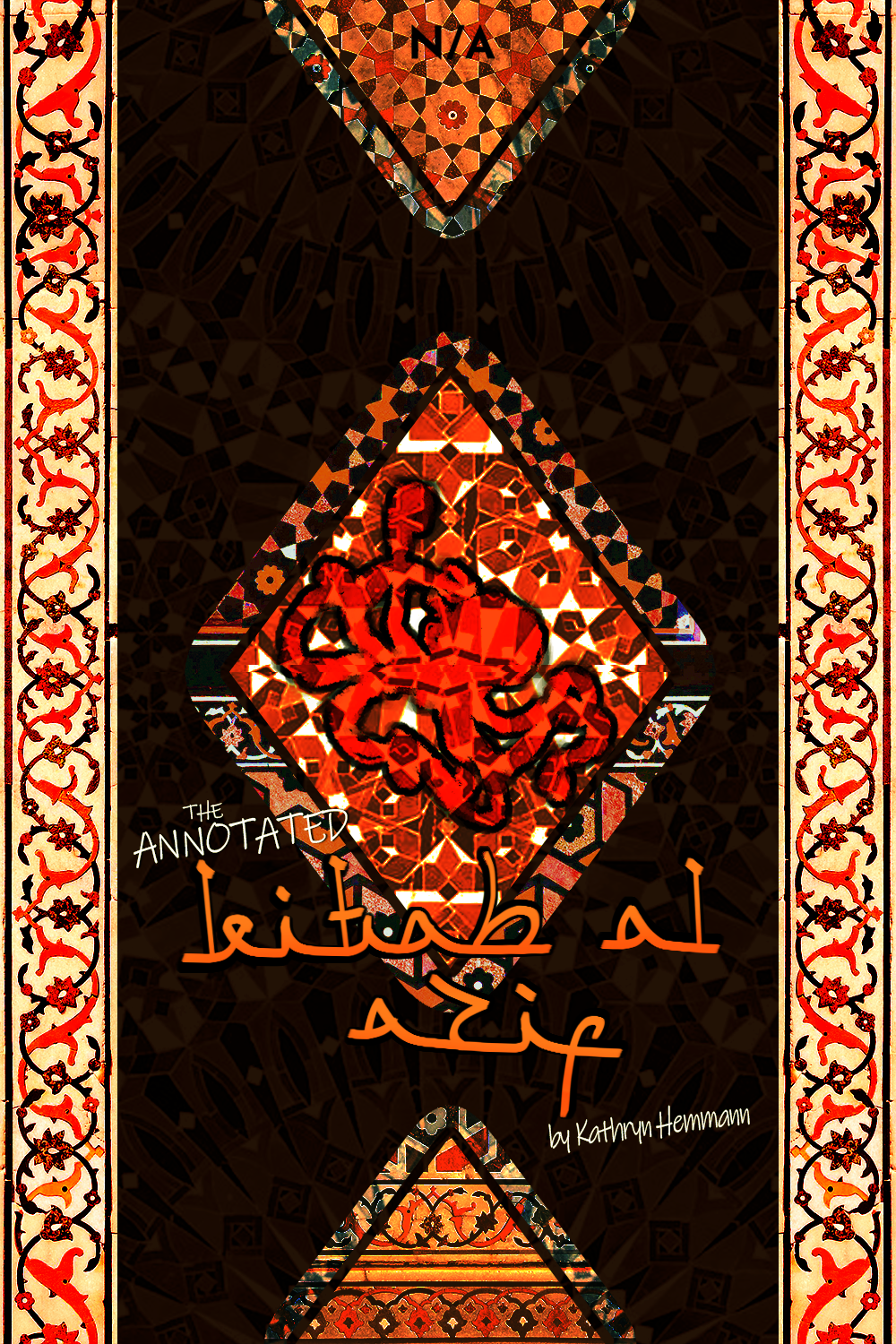
“I guess it wouldn’t hurt to talk about it,” Imad replied. He sank back in his chair as he took a long sip of tea. “At the moment I’m working on a translation of the Kitab al-Azif. This is a gnostic text that originated somewhere in the vicinity of Yemen in the early eighth century. It was believed to have potent magical properties, and it was translated into several languages over the centuries.
“Manuscripts of the Azif managed to travel around the world, but they’re remarkably rare. When I was doing research for my MA thesis, I’d see one translation or another cited in various papers, but I could never find the original source. It turns out that the only physical copies in the United States are held by the Miskatonic library, which is why I applied to do my PhD here.
“I thought it might be interesting to compare the versions to understand how key phrases were translated by different cultures. When I spoke to the head of Special Collections here at our library, she was happy to share a PDF of a tenth-century Arabic manuscript held by the Hebrew University in Jerusalem. The file isn’t the best quality, to be honest. The manuscript is a copy of a copy of a copy, and the source is badly damaged. I’m doing the best I can with what I have available.
“I’d like to write a grant to go see the original in person, but I’m not at that stage yet. Maybe next spring? I could use a vacation.” Imad shrugged and took another sip of tea. Cole was relieved to see the color returning to his face.
“So this Kitab al…”
“Azif. It’s a poetic word that refers to the chirping of nocturnal insects.”
“So this Kitab al-Azif, what’s it about? If that’s the right question.”
“No, that’s a great question. The book holds that there’s a deeper truth to the universe, and the author – we don’t know his true name – tells a remarkably coherent story as he explains what this supposed truth is. He claims that our universe is like the thin film on the surface of a bubble, and he believes that there are all manner of things outside the bubble we can’t see.
“This isn’t an original idea, but what’s interesting about the Azif is that its author provides a history of our planet long before humans lived here. Most creation myths describe humans as being brought into existence shortly after the universe itself, but the Azif speaks of genesis in terms of cycles. People that weren’t human inhabited the planet before us, and people who aren’t human will live here after us.”
“That sounds kind of Buddhist,” Cole cut in.
“Exactly! There’s a great deal of Eastern thought incorporated into these ideas. All times exist at once, simultaneously, and in different dimensions. The borders between dimensions can be weakened by magic, supposedly. By the act of reading the Azif, the creatures occupying other dimensions can be invited into our own world.”
“I’d love to meet them,” Cole remarked. “I wonder what they look like?”
Imad stared at his tea as he shifted the paper cup between his hands. “They’re probably not what you expect. I think we’ve gotten used to the strange creatures that appear in movies. When you finally see the monster on the other side of the door, it becomes familiar, like a type of mascot. We can see horrible things online whenever we want, from deep sea fish to the microorganisms that live inside our bodies, and we’ve learned to love them. But maybe there are things out there that are so alien that we’ll never be able to process them, either intellectually or emotionally.
“Gnosticism seems so natural in the twenty-first century, doesn’t it? Of course there’s a deeper truth to the universe. All we have to do is use science to figure it out. People publish their findings, and what they learn becomes real to us in the form of technological innovation. But the modern Western world didn’t invent science. Other cultures studied the stars and the principles of chemistry and physics long before Aristotle began giving lectures at his Lyceum. So why did gnostic ideas fall out of favor? Why did people stop thinking about the universe as a malleable series of experiential planes? I wonder if perhaps someone saw the monster on the other side of the door and decided that it would be better if the truth remained hidden.”
“Wow. I wish I could have recorded that.”
Imad looked up from his tea. “What do you mean?”
“That would have been a fantastic interview for my podcast. You have a great voice for audio.”
“Do I?” Imad laughed, but his mirth vanished as his face twisted into a grimace.
Cole frowned. “Listen, Imad. You’re really not looking so great.”
“I’m fine.” As Imad rose to his feet, Cole couldn’t help notice the awkward movement of his body. The way his sweaters bunched around his torso was decidedly odd. Something like a thick strip of cloth hung from the back of the layers of fabric. As Cole watched Imad leave the room, he could have sworn that it twitched.
Cole returned to campus later that evening. He unlocked the department office and sat at his desk without turning on the lights. He considered making a show of checking his email, but the performance would be for no one’s benefit but his own. As long as he was here, he might as well get this over with.
Cole wanted to tell himself he was sneaking around for Imad’s own good. That was true, to a certain extent, but it wasn’t the whole truth. He’d always regretted not investigating the waterlogged doll, and he promised himself that he wouldn’t pass up an opportunity like that again. Still, as he set off down the dim corridor of faculty offices, he couldn’t help but feel guilty. The grad student office wasn’t a private space, but that didn’t mean he wasn’t violating Imad’s trust.
There was no strange smell when he opened the office door, just the lingering aroma of bergamot tea. The two cubicles closest to the door were empty. Imad had claimed the cubicle by the window, and he’d dragged a table next to the wall behind his chair. It was covered in library books.
There was nothing unusual on Imad’s desk – a bottle of aspirin, a jumble of cheap pens, and a spare phone charger. He hadn’t pinned any photos to the corkboard cubicle divider, but a collection of thank-you cards from students was propped in a corner. Several manilla folders were stacked on top of each other in the opposite corner, each neatly labeled in Arabic.
Cole opened one of the folders. The paper inside was covered in dark smudges. This must be a copy of the manuscript scan Imad told him about. Cole didn’t know anything about Arabic, but even he could tell how bad the image quality was. It was amazing that Imad could read this at all. Interleaved between the photocopies were pages torn from a yellow legal pad. The loose papers were covered with annotations surrounding a handwritten English translation.
Cole scanned what Imad had written, but none of it made sense to him. As far as he could tell, this particular passage had something to do with constellations. The next page was a clean photocopy of what must be a Latin translation, and the next was a translation of the Latin into severely antiquated English. Under that was a printed copy of the Wikipedia page about the sky quadrants used by medieval astronomers.
Something seized in Cole’s chest as he flipped through the pages. This was exactly the sort of academic work he once imagined himself doing. A lone scholar sitting at a quiet desk with nothing but paper and a pen as he studied ancient texts, taking careful notes while excavating the meaning of words written in centuries past. There was a certain romance to the idea, and Cole wasn’t at all surprised to find that Imad’s handwriting was as beautiful as his voice.
He picked up the legal pad sitting at the center of the desk and flipped to the last few pages. A word written in capital letters immediately caught his attention: SHOGGOTH. Under it, Imad had written: “What is formless will be given form. The shoggoth will heed the call of its creator, if called in a [dream??] voice speaking its proper name. That which hides in the deathless gap between hours can be retrieved by a shoggoth, grasped within its hands without hands.”
The next page contained a series of vectors that Imad had labeled with numbers and overlaid with pencil sketches of constellations. Cole recognized the Big Dipper of Ursa Major, as well as the three stars of Orion’s Belt, but something about the angles formed by the connected lines felt wrong. Looking at them too closely made his head hurt.
The next page was a photocopy of an illuminated manuscript written in Latin. Cole didn’t understand Imad’s annotations, many of which were crossed out, but a square yellow sticky note appended to the bottom of the page caught his attention. Almost without being aware of it, he read the note out loud. “The hands without hands, fhtagn ph’nglui.”
As the words left his mouth, the image of the thick pale thread emerging from Imad’s sweaters jumped into Cole’s mind. He was struck by the smell of water. Roiling seas under an endless expanse of sky, stars and constellations without number, pinpricks of light fitting together into an intricate matrix of impossible geometry.
Something unpleasant rose in his throat. He barely made it to the bathroom in time.
Cole couldn’t leave the building quickly enough. He was sick again in the bushes beside the parking lot.
It was only sitting in his car, with the air conditioning blasting in his face, that his nausea dissipated. As he clutched the wheel, Cole chided himself for letting his imagination get the better of him. A cursed book was all well and good, but the notion of a cursed photocopy was absurd. He’d managed to spook himself for no reason. Whatever was going on with Imad had nothing to with star charts or Latin manuscripts. A section of the roof of Whateley Hall had collapsed during the heavy snowfall of the previous winter, and Cole wouldn’t be surprised if it had resulted in extensive water damage to the building. The insulation in the walls was more than likely riddled with mildew.
Someone should get Imad set up in a different office. That someone, as it happened, was him. He’d bring it up tomorrow, Cole resolved as he backed out of his parking space. Still, he was troubled by the word Imad had written in rough letters at the top of his legal pad. What the hell was a shoggoth?
Cole woke up the next morning haunted by a lingering sense of shame. What had possessed him to drive back to campus and sneak into Imad’s office? That was creepier than any cursed book could ever be. He needed to talk to Imad. Really talk to him. Maybe even ask him out to dinner.
Cole washed his hair for the first time in a week and trimmed his beard as it dried. His apartment occupied the top floor of an old Queen Anne house, and the morning sun streamed through the tall windows under the peaked gambrel roof. Songbirds chirped in the branches of the stately ash tree growing beside the house. Cole had been toying with the possibility of moving back to Ohio, but he couldn’t deny that there was a certain charm to summer mornings in New England.
In the department office, he chatted with Peggy as he handled the visa paperwork of an incoming grad student, all the while feeling a sort of secondhand pride that someone would come all the way from abroad to study at Miskatonic. He ate lunch on the outside patio with the two elderly women who ran the office of the Modern Languages department. They showed him photos of their cats on their phones and told him stories about their grandchildren as they enjoyed the sunshine. Afterward, they brushed their teeth together in the women’s bathroom on the second floor, which they agreed was the nicest in Whateley Hall.
Cole waited for Imad to come to the office. He waited so hard that he couldn’t read Wikipedia, not even the entry about the mysteriously nondescript warehouses used to house banks of internet servers. Everything he saw on social media annoyed him. Eventually he gave up on trying to do anything productive and opened a website that emulated screensavers from the 1990s.
After spending half an hour watching digital fish float through an overbright coral reef, Cole realized that he was being silly. It was a beautiful summer day. There was no need for him to kill time in an empty office while Imad was making himself sick looking at crusty photocopies of wizard nonsense for the sake of a dissertation that no one would ever read.
Cole’s palms were sweaty as he knocked on the door of the grad student office. What if Imad had noticed that his research notes had been disturbed?
“Imad?” he called out, but there was no answer. He wiped his hands on his pants before grasping the doorknob. At best, he’d have to apologize to Imad for going through his papers. At worst, he’d have to drive him to the hospital.
There was another possibility: a void, a vacuum, a tear in the fabric of reality. A window opening onto an oceanic abyss trapped beneath sheets of ice for millennia. A silent city suspended under lightless stars. A multitude of insectile eyes focused on the present moment: a miniscule oasis in the ever-expanding desert of time and space.
Cole opened the door. The office was empty.
The window was open, and a faint breeze carried the scent of freshly cut grass into the room. A ceramic mug of tea sat on the table next to a laptop with a burnished copper finish.
Cole closed the door and stepped back into the corridor, where he was greeted by a strange but familiar smell. The odor wasn’t unpleasant, just unusual. It reminded him of the lake shore where his uncles had hosted cookouts when he was a kid. He’d spent most of his summers indoors, reading his way through the local library’s paltry stock of fiction. His isolation made the outings to the lake with his cousins all the sweeter. In truth, Cole loved the smell of water, and he had a good idea of where it was coming from.
He retraced his steps down the corridor until he arrived at the bathroom by the elevators. With no hesitation whatsoever, he went inside.
At first, Cole didn’t understand the sight that greeted him. He recognized Imad’s face, but it took a few seconds to process the rest of him. Five fleshy appendages ringed with red patches of irritated skin emerged from Imad’s naked torso. The tentacles were limp but twitched spasmodically.
Beads of sweat pooled on Imad’s forehead as he stared at Cole in horror, his sweaters clutched in his hands. “Listen, I don’t… I mean, I can explain,” he stammered.
“You can explain later,” Cole replied, his concern for Imad’s discomfort winning out over his shock. “Just sit tight. Don’t go anywhere. I’ll be right back.”
Cole dashed to the department office, hoping against hope that Imad didn’t flee. He grabbed a can of ginger ale from the office minifridge and rushed back to the bathroom.
He found Imad sitting on the bench by the door. His face was utterly forlorn, and his tentacles waved listlessly in Cole’s direction.
“Buddy, you’ve got to hydrate,” Cole said, popping the tab on the can of ginger ale.
Imad accepted the can with a curt nod and drank. When he finished, he wiped his mouth with the back of his hand. “The words of the ritual,” he muttered. “The book was a historiola, but I got the words wrong. I couldn’t read them correctly.”
“Maybe you can get them to send you a better photocopy next time,” Cole replied. “For the time being, you need to take better care of yourself. Your, uh… Tentacles? Can I call them that? Whatever’s going on there. It looks like they’re irritated by your clothing. Peggy has a giant bottle of hand lotion on her desk. I’m sure she won’t mind if you use it.”
“This doesn’t bother you?” Imad asked.
“It’s not making you evil or anything, is it?”
“I don’t think so.” Imad’s shoulders sagged. “It’s just a lot to get used to. And sometimes I see things I’m not sure are actually there.”
“What type of things? Anything fun?”
Imad managed a weak grin. “Why? Do you still want to interview me for your podcast?”
“Forget the podcast. But I’d love to talk with you. I’m not busy right now. Do you want to take a walk? Maybe go out for coffee or something?”
Imad’s tentacles perked up at the question. “Are you asking me out?”
“I… yes. I’m sorry if that’s not appropriate. I don’t want to make you uncomfortable.”
“You don’t want to make me uncomfortable.” Imad stared at Cole in disbelief before breaking into laughter. His tentacles undulated with good cheer.
Cole returned his smile. He’d been worried that something was terribly wrong with Imad, but this wasn’t so bad, all things considered. Imad’s tentacles were kind of cute. Perhaps they would have been more horrific if they’d come directly from a cursed book, but there wasn’t much damage a grainy photocopy could do. Whatever this Kitab al-Azif was, he and Imad could handle it together, preferably after they’d gotten something to eat. And who knows, it might even make a good episode for his podcast.